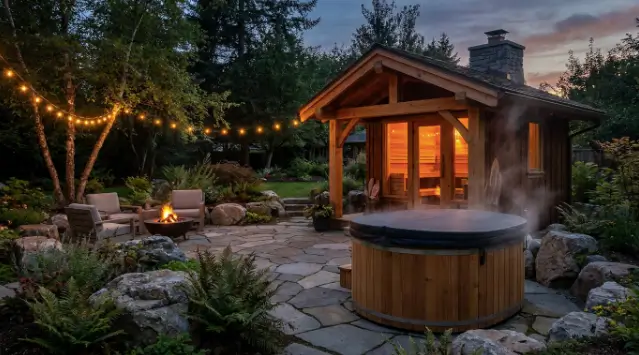
A full 6×8 or 6×9 sauna kit needs roughly 48 to 54 square feet of clear floor space, a 24 to 27 inch doorway, and about 6 feet 8 inches of ceiling clearance, and a lot of basements, garages, and bathrooms don’t have that much to give up. When the numbers don’t work, three substitutes hold up in practice: a barrel-style kit under 4 feet in diameter, a plug-in infrared cabin sized for one occupant, or a fold-flat blanket or pod that stores in a closet. Each trades interior volume for a smaller footprint, and the right pick comes down to how much room you have and how often you’ll actually use it.
How Much Room Does a Standard Sauna Kit Actually Need?
Most manufacturers publish a “clear space” number that’s larger than the kit’s own footprint. A 6×8 cabin needs the 48 square feet inside its walls, then another 6 to 8 inches of service clearance behind the heater for airflow and combustible-material spacing, plus room for the door to swing open without hitting a wall or fixture. Heaters over about 4.5 kW usually call for a dedicated 240V circuit, which means an electrician, a permit in most municipalities, and a panel with room for a new breaker. Add up the floor space, the swing radius, and the electrical work, and a lot of “we have a corner for it” rooms turn out to be too tight once you measure honestly.
Can a Barrel-Style Kit Solve a Tight Footprint?
A barrel sauna’s curved wall shape means there’s no wasted square footage in the corners the way a rectangular cabin has. Diameters commonly run from about 4 feet up to 7 feet, and a 4 to 5 foot barrel seats two adults comfortably in a footprint that would barely hold a single bench in a square kit. Barrels sit on a cradle base, usually outdoors on a deck or a poured pad, and they still need clearance on all sides for the door to open and for rain and snowmelt to run off the curved roof rather than pooling against a wall. Because most barrel kits are outdoor units, they sidestep the indoor ceiling-height problem entirely, though the doorway is often narrower than a cabin’s, so check shoulder clearance if you’re broad-framed.
Do Plug-In Infrared Cabins Fit Where Traditional Kits Can’t?
Infrared cabins are the smallest true sauna kits on the market, with single-person units built for footprints as tight as 3×3 or 3×4 feet. Most run on a standard 120V, 15 or 20 amp household outlet because the carbon or ceramic panels typically draw under 1,800 watts combined, so there’s no electrician visit or new circuit in most installs. Ceiling clearance is more forgiving too, with some models workable under 6 feet 6 inches. The tradeoff is heat style: infrared panels warm the body directly rather than heating the surrounding air the way a stone heater does, so the room itself stays cooler to the touch even during a session, and there’s no water-on-rocks steam.
What About Sauna Blankets and Portable Pods?
Blanket and pod units are the answer when there’s no floor space to spare at all. They roll or fold flat for storage in a closet, plug into any standard outlet, and set up in a few minutes on the floor or a bed frame. They’re single-person, there’s no standing room, and there’s no steam or humidity control, so they’re closer to a heat-therapy tool than a room you sit in with a friend. For renters or apartment dwellers who want the general benefit without any permanent installation, this is the only category that leaves zero footprint when it’s not in use.
Why Frequency Might Matter More Than Square Footage
The research on regular sauna use is built almost entirely around session frequency and consistency, not room size. A 2018 review in Mayo Clinic Proceedings found that more frequent sauna bathing was associated with lower cardiovascular event rates in the cohorts studied, and a separate 2018 systematic review of dry sauna bathing in Evidence-Based Complementary and Alternative Medicine reported consistent improvements in markers like arterial function across the trials it covered. Neither paper claims sauna use prevents disease, and the association doesn’t distinguish between a 6×9 cedar cabin and a compact infrared unit used just as often. In practical terms, a small kit you actually step into four times a week likely does more for you than a large one that sits unused because the room never got finished.
Where to Compare Compact Kit Footprints and Pricing
Compact barrel kits sized under 4 feet in diameter typically run $2,200 to $3,800 before shipping, while single-person infrared cabins land closer to $1,200 to $2,500 depending on panel material and cabinet wood. Specialty retailers such as Sweat Decks carry several footprints side by side, which makes it easier to compare interior dimensions and amperage draw before committing to a size, rather than guessing from a single big-box listing. Measure your actual space first, including door swing and any sloped ceiling, then shop against those numbers instead of a generic “small room” assumption.
What Electrical Service Do Compact Kits Actually Need?
The dividing line is usually 1,800 watts. Below that, most infrared cabins and blanket units are plug-and-play on a standard household circuit, provided nothing else heavy is sharing that circuit. Above it, and for any traditional stone-heater kit regardless of size, plan on a dedicated 240V line sized to the heater’s nameplate rating, which almost always means hiring a licensed electrician and, in many jurisdictions, pulling a permit before the heater goes live. It’s worth confirming this before you buy rather than after the kit arrives, since the electrical work can cost more than a compact heater itself.
Frequently Asked Questions
Can a sauna kit fit in a small bathroom or garage corner?
A single-person infrared cabin or a fold-flat blanket can fit in as little as 9 to 12 square feet. A bathroom needs added moisture control since most kits are built for dry ambient air, not a wet shower environment.
Do compact sauna kits need a dedicated electrical circuit?
Units under about 1,800 watts usually run on a standard 15 or 20 amp household outlet. Traditional kits with heaters over 4.5 kW almost always need a dedicated 240V circuit sized to the heater’s spec sheet.
How much shorter is heat-up time for an infrared cabin versus a traditional kit?
Infrared panels typically reach a usable session temperature in 10 to 15 minutes. A stone heater in a traditional kit commonly takes 30 to 45 minutes to bring the room and rocks up to temperature.
Will a compact kit still deliver a real sweat, not just warm air?
Yes. In a small enclosure, a 1,500 to 1,800 watt infrared panel or a right-sized electric heater raises air temperature to 110 to 130 degrees Fahrenheit, enough for a genuine session even though the room itself is small.
Can I add a compact kit outdoors if I have no indoor space at all?
Barrel and small cabin kits are built for outdoor placement on a level pad or deck, provided you leave clearance for the door swing and roof runoff, plus weatherproof cable routing back to the electrical panel.
References
- Kunutsor SK, et al. “Cardiovascular and Other Health Benefits of Sauna Bathing: A Review of the Evidence.” Mayo Clinic Proceedings, 2018. https://pubmed.ncbi.nlm.nih.gov/30077204/
- “Clinical Effects of Regular Dry Sauna Bathing: A Systematic Review.” Evidence-Based Complementary and Alternative Medicine, 2018. https://pubmed.ncbi.nlm.nih.gov/29849692/
- “Benefits and risks of sauna bathing.” The American Journal of Medicine, 2001. https://pubmed.ncbi.nlm.nih.gov/11165553/
By Nathan Pierce
